FUSION BEARDED DRAGONS

Purchase and care pack

Fixed document version: 2026-11-22-93d6f85873365097

This is the Terms, Privacy Policy and care information supplied with purchase forms carrying this version. Your personal submission and acknowledgement are recorded separately in your receipt. This document does not confirm an order, payment, licence approval or reservation.

Terms and Conditions

Legal

Terms and Conditions

The conditions that apply when buying a Central Bearded Dragon directly from Fusion.

Privacy Policy

Privacy

Privacy Policy

How Fusion collects, uses and protects information provided through enquiries, forms, purchases and after-sale support.

Care Guide overview

Fusion Bearded Dragons

Care guide

One care resource, organised in three levels so visitors can find a quick answer or work through the complete guide.

Find your answer

Where should I start?

Use Quick Start to plan the essential setup. Open the Complete Guide for day-to-day husbandry and detailed care. The Knowledge Centre explores the species and broader questions about genetics, behaviour and research.

Evidence

How information is identified

References appear where research supports the information. Limited or conflicting evidence is identified. Information based on practical experience rather than published research is identified as Fusion experience.

Research supportedFusion experienceLimited or conflicting evidence

1. Foundations

Complete Care Guide

Foundations

How the guide works, why the environment comes first and the principles behind Fusion’s system.

Introduction

How To Use This Guide

Introduction

Why The Environment Comes First

In our experience, issues such as not eating, hiding and avoiding the basking area are frequently linked to an incorrect environment. Skin problems can also be affected by husbandry, but these signs are not specific and illness must still be considered when symptoms are persistent, severe or accompanied by other changes.

When setups are corrected to align with the standards in this guide, behaviour typically improves within days. The animal did not change. The conditions did.

The focus must always be on the environment first. When the setup is right, the animal responds accordingly. Treating symptoms without correcting the environment rarely produces lasting results.

This is not a theory. It is the consistent result we see when these standards are followed.

Introduction

The Foundation

Every part of this guide matters, but the following are the conditions we consider essential. These are non-negotiable and must be in place from day one.

UVB

T5 High Output (10% or 12%) mounted inside the enclosure, covering ½–⅔ of the enclosure length from the hot end. Replace every 12 months.

Heat source

For daytime basking, use an overhead heat light. Halogen or natural-spectrum bulbs are preferred. Do not use heat mats or heat cables. Ceramic heat emitters are not suitable as the primary daytime basking heat source. The limited nighttime exception is explained under Temperature Setup.

Thermostat

Required for all heat sources without exception.

Basking temperature

42–45°C surface temperature. Can reach ~50°C at peak. Measured with an infrared temperature gun only.

Cool end

~28°C or below.

Lighting cycle

12 hours on / 12 hours off. Up to 14 hours in summer. Timers required.

Enclosure size

Fusion’s recommended enclosure size is 1,200 × 600 × 600 mm (approximately 4ft × 2ft × 2ft) for a single Central Bearded Dragon.

Enclosure material

Melamine preferred. PVC suitable. Glass is not recommended.

Substrate

Artificial turf or appropriate sand.

Backgrounds

No 3D backgrounds until 6–9 months old. Do not use a 3D background at any age during Fusion's voluntary three-month health guarantee.

Calcium + D3

Applied daily for the first year.

Feeding location

Always feed inside the enclosure.

Introduction

Our Goal

A thriving bearded dragon is not hard to recognise. It basks confidently in the morning, moves between zones throughout the day, engages with its environment, eats readily, and is alert and responsive to handling.

That is what we are aiming for — not just survival, but an animal that is genuinely healthy, active, and thriving in its environment.

This guide exists to give you the knowledge to create exactly that. Not through guesswork or trial and error, but by understanding what a bearded dragon actually needs and building an environment that delivers it.

When the environment is correct, the rest follows naturally. That is the goal.

Introduction

Core Principles

Nature has the plan — we create the conditions.

Bearded dragons come from hot, open arid zones where they have access to intense UV radiation, overhead radiant heat, strong light cycles, and a clear temperature gradient. These are not luxuries — they are biological requirements.

Captivity does not remove instinct or biology. It only changes the environment those instincts must operate within.

We cannot replicate that environment literally. What we can do is understand the function each element serves and recreate those functions accurately within a controlled space.

This means we are not focused on making an enclosure look natural. We are focused on making it function correctly for the animal.

When an enclosure is built around this principle, the dragon's instincts have everything they need to operate. The animal basks, thermoregulates, hunts, rests, and behaves as it should.

When it is not built around this principle, the instincts have nothing to work with. The result is an animal that cannot regulate its own body correctly, regardless of how it looks or how well-intentioned the keeper is.

Build the conditions. Trust the instincts. The animal does the rest.

Introduction

Why We Do Things Differently

Most care information available today focuses on products, decoration, or isolated pieces of advice.

Our approach is different. We do not build enclosures around trends, aesthetics, or what looks natural to people. We build them around function — what the animal biologically requires in order to regulate itself correctly.

When the conditions are correct, the animal's instincts do the rest.

This means focusing on
  • Correct heat before decoration
  • Functional UVB before accessories
  • Stability before constant changes
  • Simplicity before unnecessary complexity

A well-designed enclosure should support natural behaviours automatically. The dragon should be able to bask, cool down, hunt, rest, and regulate itself without constant intervention.

In our experience, many common problems arise when keepers attempt to override instinct instead of supporting it. Excessive handling, constant enclosure changes, overcomplicated setups, conflicting advice, and trend-driven products often create more problems than they solve.

Our goal is not to create the most complicated setup. Our goal is to create conditions that work consistently.

That philosophy shapes everything in this guide.

Introduction

Natural Instincts

Basking in heat and light

Bearded dragons actively seek heat and strong light together. Basking allows behavioural thermoregulation, while appropriate UVB exposure supports Vitamin D3 metabolism. A correct basking zone is therefore central to normal activity, digestion and calcium metabolism.

Active thermoregulation

Bearded dragons do not remain in one spot all day. They move between warm and cool areas throughout the day to maintain an internal temperature range. A functioning cool end is just as important as a correct basking zone.

High point basking

Central Bearded Dragons commonly use elevated positions for basking and observation. In our experience, many will favour the highest usable point in an enclosure, so the basking structure should provide safe height and a choice of exposure beneath the heat and UVB.

Security and awareness

Bearded dragons instinctively position themselves where they can see their surroundings. A hide or enclosed space at the cool end satisfies the need for security when resting, while an open basking position satisfies the need for awareness when active.

Territorial awareness and routine

Bearded dragons are territorial and thrive on consistency. Once a routine is established, they will follow it reliably. Disrupting the environment — through constant changes, new objects, or inconsistent lighting — creates stress and suppresses normal behaviour.

Survival through balance

All of these instincts work together. When the enclosure supports them, the dragon regulates correctly, feeds confidently, and behaves predictably. When one or more are unsupported, the entire system is affected.

Introduction

From Instinct To Environment

Every instinct covered in the previous section has a direct, practical implication for how an enclosure must be set up. This guide is built around those implications.

Nothing in a well-built enclosure is accidental. Each decision maps back to a biological need. Understanding this connection is what separates a setup that works from one that merely looks correct.

2. Environment & Enclosure

Complete Care Guide

Environment

Building and arranging an enclosure around the animal’s physical and behavioural needs.

Building Your Enclosure

The enclosure is a controlled system, not just a space. Every element inside it must serve a function. If it does not serve a function, it does not belong in the enclosure.

Fusion recommends an enclosure measuring 1,200 × 600 × 600 mm (approximately 4ft × 2ft × 2ft) for a single Central Bearded Dragon. In our experience, this size provides suitable space while making it easier to establish and maintain the temperature gradient, heating and lighting described in this guide. It also supports the Victorian Code of Practice requirements that a reptile enclosure provide adequate horizontal and vertical space, allow exercise and accommodate a functional thermal gradient. Larger enclosures can be used, but require more planning, setup and monitoring to achieve the correct conditions throughout. Detailed setup advice for larger enclosures is outside the scope of this guide.

Start with the essentials only: a basking structure at the highest accessible point, a hide at the cool end, food and water bowls, and substrate. Add anything else only once the core setup is working correctly.

Enclosure material

Melamine is Fusion’s preferred enclosure material because it is practical, stable and easier to configure for the controlled conditions used in this guide. PVC is a suitable alternative — lighter than melamine and more moisture resistant, though slightly less rigid. Either can work correctly when set up properly. Fusion does not approve glass aquariums or fish tanks for its dragons. They can make heat retention, reflection control and internal equipment mounting more difficult. Repetitive interaction with transparent barriers can have several causes, so glass surfing should not be attributed to reflections alone without checking the complete setup.

Substrate

Fusion uses short-fibre artificial turf and also accepts appropriate sand when the complete setup, hygiene and feeding practices are correct. Loose substrate risk is not explained by one factor alone; material, particle size, ingestion, hydration, nutrition, temperature and the individual animal can all matter. Fusion does not recommend bioactive setups within this care system. They can be managed successfully by experienced keepers, but moisture, substrate composition, cleaning and biological activity add variables that make Fusion’s required conditions harder to assess and control.

What to avoid
  • Fake plants — dragons may eat them, causing injury or impaction
  • 3D backgrounds until 6–9 months — once basking behaviour is established and the dragon is eating and thermoregulating correctly, they can be introduced, but not during Fusion's voluntary three-month health guarantee
  • Soft furnishings such as fabric hides — they harbour bacteria
  • Excessive clutter — blocks movement, reduces confidence, causes stress

Begin with a simple, functional setup that reliably provides the correct heat, UVB, gradient and security. Once those foundations are stable, appropriate climbing opportunities, hides and usable environmental complexity can be added, provided they do not obstruct movement or make the enclosure conditions more difficult to control. The main basking position should ideally remain the highest accessible point, positioned correctly beneath the heat source and UVB.

Enclosure Layout

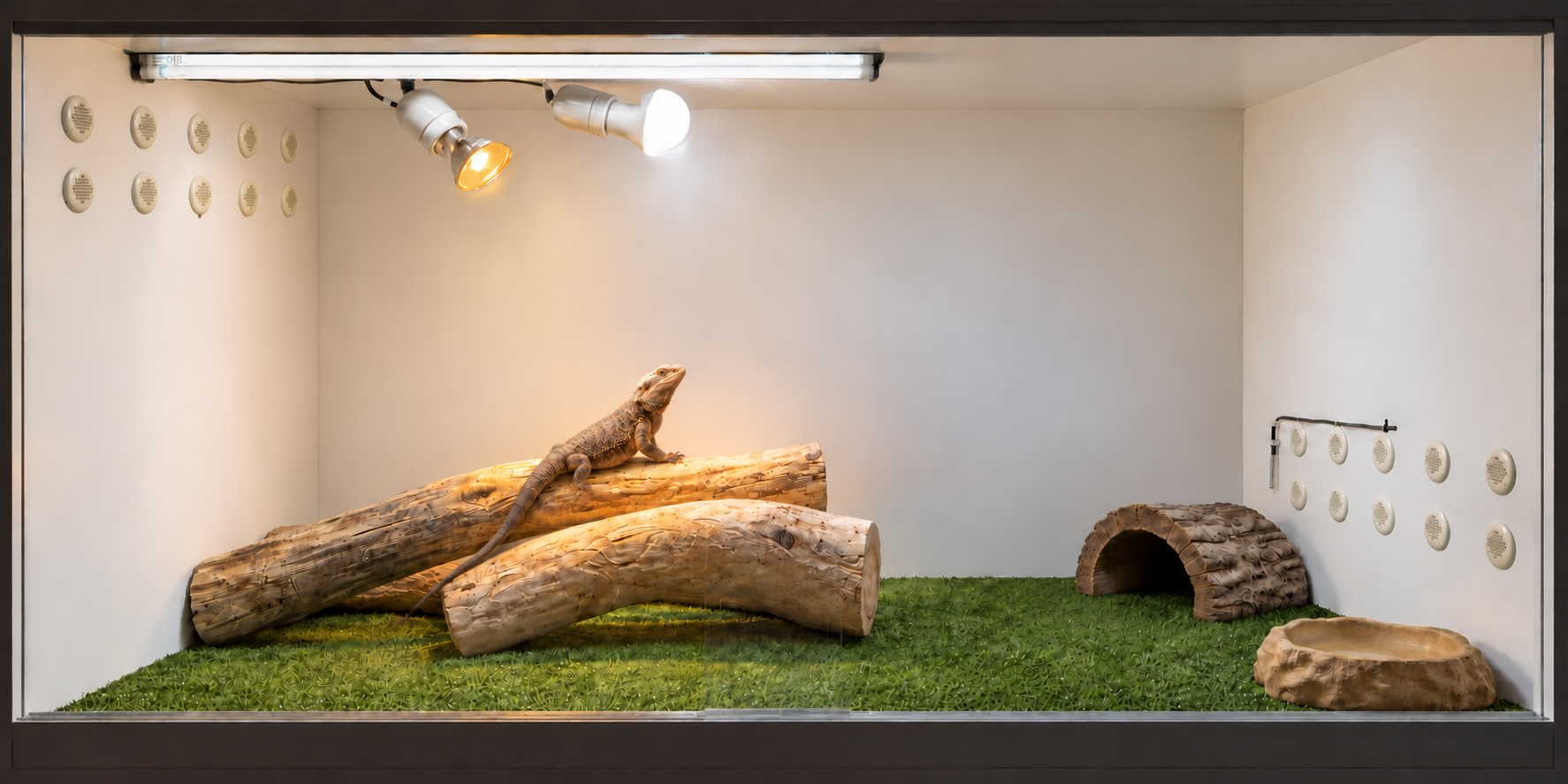
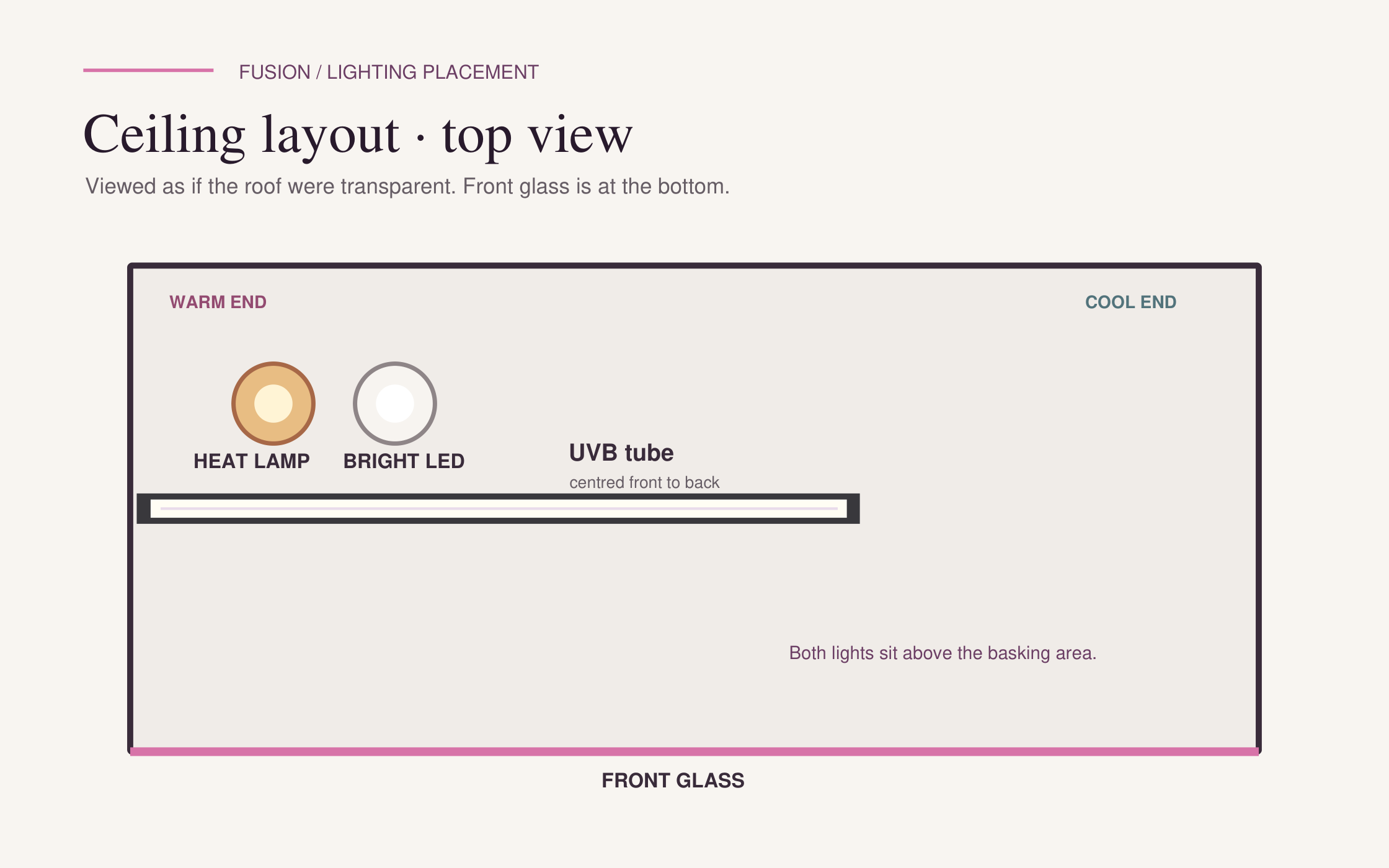
The 3D view shows how the basking structure, hide and water bowl sit beneath the lighting. The ceiling plan shows where the UVB tube, heat lamp and bright LED sit in relation to one another.

The dragon has climbed to the highest point of the logs beneath the basking lamp and UVB. From there it can bask while surveying the enclosure, then move lower along the wood or retreat to the cooler end when it needs less heat or light. The hide offers another place to withdraw, and the water bowl remains accessible on the cool side.

These images illustrate placement and natural choices; they do not replace measuring the actual basking surface, cool end and UVB exposure in your own enclosure.

Front view of Fusion's enclosure showing a dragon basking on the highest log under the heat lamp and UVB, with a hide, water bowl and cool-end probe
Enclosure layout · front view
Ceiling plan showing the UVB tube extending from the left over the basking zone, with heat and LED lamps beside it
Lighting placement · top view
Basking surface

42–45°C. Dragon climbs to highest point to bask directly under the heat source.

UVB position

Must overlap the basking zone — spans ½–⅔ from hot end.

Thermostat probe

Positioned at the cool end. The cool end should sit at approximately 28°C or below.

Temperature gradient

Always provide a gradient so your dragon can move away from heat as needed.

Functional Basking Structures

The basking structure itself is extremely important and is something many setups get wrong.

In our experience, the best basking surfaces are natural-style logs or branches that gradually taper in height beneath the heat source and UVB. The highest point should sit directly beneath the basking light, with the structure gradually lowering away underneath the UVB zone.

This creates a usable gradient that allows the dragon to naturally regulate itself throughout the day.

Flat basking surfaces such as tiles, pavers, slate platforms, and large flat rocks are often not ideal, particularly for young dragons.

While these surfaces may absorb heat well, they do not create the same functional thermoregulation opportunities as a properly positioned tapered log. A flat surface forces the animal into a single exposure zone with limited adjustment options.

In nature, healthy active bearded dragons are most commonly seen basking on elevated branches, logs, fence posts, and uneven natural surfaces rather than broad flat platforms. One of the more common exceptions is gravid females, which are often observed utilising roads and flatter heat-retaining surfaces while carrying eggs.

This is one reason we strongly favour large tapered logs positioned beneath the heat source and UVB. The highest point should sit directly beneath the basking light, gradually tapering downward through the UVB zone. This creates a usable gradient that allows the dragon to naturally regulate itself throughout the day.

Over the years we have repeatedly seen young dragons housed on flat basking surfaces become inactive, reluctant to bask properly, or simply fail to thrive despite temperatures appearing correct on paper. In many cases, replacing the surface with a large tapered log resulted in dramatic behavioural improvement within days.

The dragon became more active, basked more naturally, moved through the gradient correctly, and began regulating itself the way it was intended to.

The goal is not simply to provide heat. The goal is to provide a functional basking environment the animal can actually use properly.

3. Heat, Light & Climate

Complete Care Guide

Heat & Light

Heating, temperature, UVB, humidity, common mistakes and seasonal behaviour.

Heating & Lighting

Heating Setup

How it works

Bearded dragons are diurnal — active during the day, resting at night. During the day, they require a strong overhead heat source that replicates solar radiation. At night, no supplemental heat is required in most Australian climates unless the temperature drops below 5°C.

Overhead heating only

Heat must come from above. Bearded dragons are built to absorb radiant heat from above, as they would from the sun. Heat mats, heat cables, and under-tank heaters do not replicate this and can cause burns, stress, and thermoregulation failure.

Bulb type

Halogen bulbs or other bright, natural-spectrum globes are preferred for daytime basking. Avoid coloured or red bulbs. Ceramic heat emitters do not provide the light component of basking and are not suitable as the primary daytime basking heat source.

Thermostat

All heat sources must be controlled by a thermostat without exception. The Inkbird ITC-306T is recommended for reliability and ease of use. The thermostat probe must be positioned at the cool end, not at the basking zone.

Basking structure

The shape and positioning of the basking structure matter just as much as the temperature itself. Tapered natural logs positioned beneath the heat source and UVB provide a far more functional basking gradient than flat rocks or tiles.

Measurement

Always use an infrared temperature gun to measure surface temperatures. Stick-on thermometers and dial gauges are not accurate enough for this purpose and should not be used as a primary measurement tool.

Heating & Lighting

Temperature Setup

Basking zone

The basking surface temperature should sit between 42–45°C, and may briefly peak near 50°C directly under the basking zone during the hottest part of the day. This is measured on the surface of the basking structure directly under the heat source, using an infrared temperature gun.

Cool end

The cool end should sit at approximately 28°C or below. This temperature allows the dragon to move away from the heat source and cool down as needed. Without a functional cool end, the dragon cannot thermoregulate.

Achieving the right temperature

Temperature is controlled primarily by the height of the basking structure relative to the heat source. Raising the structure increases surface temperature; lowering it decreases it. The wattage of the bulb and the thermostat setting also affect the result.

Thermoregulation

Bearded dragons follow a natural biphasic activity pattern — basking in the morning to reach operating temperature, moving to cooler areas midday, and returning to the basking zone in the afternoon. A correctly set up enclosure will allow this to happen without intervention.

Night temperatures

Healthy Central Bearded Dragons generally do not require supplemental heating overnight unless the enclosure temperature falls below approximately 5°C. Around Whyalla, winter temperatures can fall into the low single digits, and dragons have been observed emerging to bask after mornings of approximately 3–4°C once sunlight and radiant heat become available. This natural comparison supports allowing a normal overnight temperature drop, but captive dragons should not be deliberately exposed to extreme cold. Very young, unwell, underweight or medically compromised dragons may require different management. Below approximately 5°C, a low-wattage ceramic heat emitter controlled by a thermostat can be used. Heat mats must not be used.

Heating & Lighting

UVB Lighting

Why UVB is essential

Bearded dragons are adapted to intensely bright, open environments. Bright visible light supports activity, feeding response, and natural behaviour. UVB is an inseparable part of that — it enables the production of Vitamin D3, which is required for calcium absorption. Without adequate UVB, calcium cannot be processed correctly regardless of supplementation. The result, over time, is metabolic bone disease.

UVB is invisible

UVB output cannot be seen by the human eye. A bulb can appear bright and functional while producing no usable UVB. This is why tubes must be replaced every 12 months, even if they still appear to be working.

Setup requirements

Fusion’s standard is a reputable T5 High Output UVB tube rated at 10% or 12%, mounted inside the enclosure rather than above mesh or glass. It must overlap the basking zone and extend from the hot end across approximately half to two-thirds of the enclosure. The percentage printed on the tube does not, by itself, determine how much UVB reaches the dragon. The lamp model, reflector, mounting distance, obstructions and age of the tube all affect the resulting exposure. Follow Fusion’s approved positioning for the selected equipment and replace the tube every 12 months unless its output is being reliably measured with an appropriate UV meter.

Replace every 12 months

UVB output degrades over time even when the tube still appears to be lit. Fusion’s standard is to replace the tube every 12 months unless its output is being reliably measured with an appropriate UV meter.

Light cycle

Use a timer to maintain a consistent daily lighting schedule. Standard months: 12 hours on, 12 hours off. During summer, up to 14 hours on is appropriate. Consistency in the light cycle supports natural behaviour and appetite.

Heating & Lighting

Humidity

Humidity naturally changes throughout the day and across the seasons. Fusion generally aims for approximately 30–40% through much of the active daytime period. This is Fusion’s practical enclosure target based on our experience, rather than a scientifically established line between safe and unsafe humidity. Whyalla provides a useful natural comparison. Average afternoon humidity ranges from approximately 38% during summer to 54% during winter, while morning averages are considerably higher. Temporary increases above 50%, particularly overnight and during cooler weather, are therefore not automatically abnormal or harmful. The greater concern is an enclosure that remains persistently damp, has wet substrate or condensation, or lacks adequate airflow. These conditions can encourage mould and microbial growth and may contribute to health problems. Good ventilation and a clean, dry enclosure are more important than attempting to maintain one exact humidity reading at all times.

Ideal humidity range
  • Approximately 30–40% is Fusion’s practical target through much of the active daytime period
  • Short-term rises above 50%, particularly overnight and during cooler weather, can be normal and are not automatically harmful
  • Avoid persistent dampness, wet substrate, condensation and inadequate airflow rather than treating one humidity reading as a universal danger threshold
Why it matters
  • Persistently damp conditions and inadequate airflow can encourage mould and microbial growth and may contribute to health problems
  • Extremely dry conditions may contribute to difficult sheds, though this is far less common than problems caused by excess humidity
Practical setup tips
  • Maintain good ventilation throughout the enclosure
  • Cross ventilation is strongly recommended. Air should be able to move naturally through the enclosure rather than becoming trapped or stagnant.
  • High vents should ideally be positioned either high on the side panels or directly behind the heat source where rising warm air naturally accumulates. Lower vents should ideally be positioned toward the opposite side or across the lower front of the enclosure where fresh air can be drawn inward.
  • As warm air expands and rises, it naturally exits through the upper vents while drawing cooler fresh air in through the lower vents. This creates natural cross ventilation and helps prevent stagnant heat, stale air, and excess humidity buildup within the enclosure.
  • Poor airflow often causes enclosures to hold excessive heat and humidity despite temperature readings appearing correct on paper. Proper airflow is part of creating a stable, functional environment rather than simply achieving target numbers.
  • In our experience, enclosures with poor ventilation are far more likely to develop persistent humidity issues, condensation, stale odours, and respiratory-related problems over time.
  • Avoid frequent misting — hydration should come primarily from food, drinking, and occasional bathing
  • Use dry, appropriate substrates and avoid damp conditions within the enclosure
  • Fusion does not recommend bioactive setups within this care system because moisture, substrate composition, cleaning and biological activity add variables that make the required conditions harder to assess and control

Heating & Lighting

Common Mistakes

Check your setup against this list before assuming something is wrong with the animal. The majority of behavioural and health issues we see are the result of one or more of the following.

  • Measuring air temperature instead of surface temperature at the basking zone
  • Relying on a thermostat probe or stick-on thermometer to measure basking surface temperature
  • UVB tube not overlapping the basking zone
  • UVB tube mounted on top of mesh or glass rather than inside the enclosure
  • Using heat mats, heat cables, or any under-tank heating
  • UVB spanning the entire enclosure rather than starting from the hot end
  • No thermostat in use
  • Thermostat probe placed at the basking spot rather than the cool end
  • Basking structure not positioned at the highest accessible point
  • UVB output blocked by domes, cages, or guards
  • Overcomplicating the enclosure layout

Heating & Lighting

Brumation

Brumation is a natural seasonal slowdown that many Bearded Dragons experience during the cooler months. It is often compared to hibernation in mammals, however reptiles do not enter the same deep uninterrupted sleep. Instead, activity levels reduce significantly, dragons sleep more frequently, eat less or stop eating altogether, and conserve energy until conditions improve.

In the wild, brumation is triggered by shorter daylight hours, weaker sunlight, cooler temperatures, and reduced food availability. Even in captivity, many dragons still follow these deeply ingrained seasonal instincts despite having access to food and heating year-round.

Captivity does not remove instinct or biology. It only changes the environment those instincts operate within.

Not all Bearded Dragons will brumate and those that do can behave very differently. Some may only slow down for a few weeks, while others may disappear into hides for several months. Some dragons brumate every year like clockwork while others may only do it occasionally.

Common signs of brumation
  • Sleeping more frequently
  • Going to bed earlier
  • Reduced appetite or refusing food
  • Pooping less often
  • Increased hiding behaviour
  • Spending more time on the cool side
  • Reduced activity levels
  • Digging or attempting to bury themselves

One of the most important things to understand is that many signs of brumation can also resemble symptoms of illness or incorrect husbandry.

Poor heating, weak UVB lighting, low basking temperatures, dehydration, parasites, illness, or incorrect enclosure setups can all cause lethargic behaviour that people mistakenly label as brumation.

For this reason, husbandry should always be checked carefully before assuming a dragon is simply brumating.

In properly maintained dragons with correct heating, UVB exposure, nutrition, hydration, and overall husbandry, brumation is usually a normal biological process rather than an immediate cause for concern.

Many problems commonly blamed on “parasites” or illness during seasonal slowdowns are often linked to underlying husbandry issues instead. Correct environmental conditions should always be the foundation before assuming more serious problems are present.

Healthy Bearded Dragons maintained under correct environmental conditions are generally far more robust and biologically capable than many people realise.

Young dragons & brumation

Adult Bearded Dragons generally handle brumation far better than rapidly growing juveniles. Younger dragons are still developing and require consistent feeding, strong UVB exposure, and proper basking opportunities to support healthy growth. Realistically, if you’ve purchased your dragon from a reputable breeder, it will often be around 4–6 months old by the time seasonal slowdowns commonly begin around April and May. At this age, a few quiet days up to around two weeks can be normal, however prolonged inactivity should not simply be ignored. Encouraging them back under the basking area each morning can help maintain proper digestion, activity levels, and continued development. If the dragon is younger than 4 months old, it is generally recommended to encourage daily basking and maintain slightly warmer enclosure temperatures if necessary, particularly on the cool end. While some juveniles may show mild seasonal slowdowns, prolonged brumation in very young dragons is generally not ideal and should be monitored carefully.

What to do during brumation
  • Continue providing fresh clean water at all times
  • Allow access to hides or digging areas
  • Avoid constantly disturbing or waking them
  • Monitor body condition and weight
  • Ensure any food eaten can still be fully digested under proper basking temperatures
  • Only reduce lighting hours or temperatures if true brumation is clearly occurring

Brumating dragons should not experience rapid weight loss or deteriorating condition. A healthy dragon may lose a small amount of weight during brumation, however significant weight loss, sunken fat pads, dehydration, discharge, wheezing, or visible weakness should never be ignored.

When to seek veterinary advice
  • Your dragon is very young
  • Weight loss becomes significant
  • Breathing appears abnormal
  • There is discharge from the nose or mouth
  • Weakness becomes severe
  • The dragon refuses to recover after brumation
  • You are unsure whether the behaviour is illness or brumation

Brumation is a normal biological process, not something to fear. In many cases the best approach is simply maintaining correct environmental conditions, monitoring the dragon carefully, and allowing natural instincts to operate safely.

4. Feeding & Nutrition

Complete Care Guide

Feeding

Feeding by age, growth and body condition, wild diet evidence, water, live food, vegetables, supplementation and schedules.

Feeding Overview

Bearded dragons are omnivores. They require a balance of live insect protein and plant matter, with the ratio shifting as the animal matures. Juveniles are primarily insectivorous; adults eat a higher proportion of plant matter.

Always feed during the day while lights are on and the enclosure is at full temperature. Feeding at night or before the enclosure has warmed up interferes with digestion and can cause serious health issues.

Always feed inside the enclosure. This supports natural hunting behaviour, maintains feeding confidence, and avoids creating an association between being removed from the enclosure and being fed.

At Fusion, we raise our bearded dragons on crickets as their staple live food. We recommend starting with crickets and introducing variety once your dragon is eating consistently.

Feeding By Age

Baby (0–4 months)

Growth is rapid and protein is the priority. Offer insects 2–3 times per day and leave a small number in the enclosure between feeds. Fresh vegetables should be offered daily, even if they are ignored initially. Dust all food with calcium + D3 at every feed.

Juvenile (4–12 months)

Growth continues but begins to slow. Offer insects once or twice daily. Continue offering vegetables daily. Calcium + D3 at every feed.

Sub-adult to adult (12 months+)

The diet naturally shifts at this stage. Offer insects every other day or a few times per week. Vegetables should now form a larger proportion of the diet and should be offered daily. Calcium + D3 at every feed for the first year, then every other day once fully mature.

Do not continue heavy juvenile-style insect feeding into adulthood. Overfeeding insects is one of the most common causes of obesity and poor body condition in adult dragons.

Feeding

Feeding For Growth & Body Condition

An age-based feeding schedule is a practical starting point, but individual needs vary. Feeding should also be adjusted for growth rate, size and body condition, activity, appetite, reproductive status, health, and the type and size of insects being offered.

Faster growth is not always better. Young dragons need sufficient energy and nutrients to develop normally, but this does not mean providing unlimited insects or deliberately aiming for the fastest possible growth. Appetite alone is not proof that more food is required.

Abundant high-energy food may encourage rapid growth and excessive body condition. In females, it may also allow reproductive condition to be reached earlier. However, research has not established that overfeeding alone directly causes reproductive disease.

What to monitor
  • Changes in weight over time
  • Overall body shape and proportion
  • Activity and normal movement
  • Growth without excessive body condition

There is no single ideal weight that applies to every Central Bearded Dragon. Assess the whole animal rather than relying on appetite or one number alone.

As growth slows, reduce live food gradually rather than continuing a heavy juvenile feeding pattern. Fresh plant matter should continue to be offered. Do not use crash diets or suddenly withhold necessary nutrition.

Reproductive, unwell or underweight dragons may require an individual feeding plan developed with an experienced reptile veterinarian.

Feeding

What Wild Central Bearded Dragons Eat

A field study examining the stomach contents of free-ranging Central Bearded Dragons confirms that they are omnivores and consume both animal and plant matter.

That study does not establish one universal captive percentage. Its findings describe the animals sampled at a particular place and time, and the available foods around them. Wild diet can change with age, season, rainfall, insect availability, reproductive activity and opportunity.

Wild dragons also move, forage and expend energy differently from many captive dragons. A percentage measured in one wild sample should not automatically be treated as an exact feeding rule for every captive animal.

Feeding

Water & Hydration

Fresh drinking water must always be available in a clean, stable bowl that the dragon can access easily. Replace the water daily and whenever it becomes contaminated.

Central Bearded Dragons obtain moisture from both food and drinking. Some drink openly, while others may only drink occasionally or when nobody is watching. Not seeing a dragon drink does not prove that it never uses its water bowl.

Vegetables and appropriately hydrated live food contribute moisture, but they should not be used as a reason to remove access to drinking water.

Possible signs that require attention
  • A noticeable reduction in normal activity
  • Persistent loss of appetite
  • Reduced or unusually dry droppings
  • Markedly thick or abnormal urates
  • Sunken-looking eyes
  • Ongoing weight loss
  • Weakness or a general decline

None of these signs proves dehydration by itself. They can also occur with illness, incorrect temperatures, reproductive activity, brumation or other problems.

Bathing should not be treated as the primary way to hydrate a dragon. Some dragons may drink while bathing, but routine bathing has not been shown to replace normal access to drinking water and moisture within the diet.

A sudden increase or reduction in drinking, particularly when accompanied by changes in urination, appetite, weight or behaviour, should be discussed with an experienced reptile veterinarian.

Live Food & Vegetables

Recommended live foods

At Fusion, we raise our bearded dragons on crickets as their staple live food. We also recommend woodies (wood roaches) and black soldier fly larvae to give your dragon variety.

A note on Dubia roaches. We previously fed Dubia roaches to our dragons and recommended them in earlier versions of this guide. Under current Australian rules, it’s illegal to keep, breed or trade live Dubia roaches, so please use crickets, woodies or black soldier fly larvae instead. If the rules change to allow Dubia roaches to be kept and used as feeders where you live, they could be included in your dragon’s diet again.

Live foods to avoid
  • Mealworms — Fusion does not recommend them as a staple, particularly for young dragons; they are relatively high in fat and have an unfavourable calcium-to-phosphorus balance. A direct claim that their shell alone causes impaction has not been established.
  • Superworms — high fat, biting risk
  • Wild-caught insects — parasite and pesticide risk
Recommended vegetables
  • Rocket
  • Coriander
  • Choy sum
  • Butternut pumpkin
  • Endive
  • Dandelion greens
  • Bok choy
Vegetables to avoid
  • Spinach — contains oxalates and is not recommended by Fusion as a regular staple; an occasional small amount is different from a diet based on spinach.
  • Iceberg lettuce — no nutritional value
  • Avocado — toxic
  • Onion and garlic — toxic
  • Rhubarb — toxic
On refusing vegetables

Very common early on. Do not stop offering them. Keep variety consistent, offer fresh daily, and try mixing with a small amount of live food to encourage interest. Persistence is the only approach that works.

Supplementation

Calcium + D3

Fusion’s feeding system uses a reptile-specific calcium supplement containing D3 at every feed during the first 12 months, then generally every other feed once fully mature. This is Fusion’s operational standard for dragons raised and guaranteed under this complete system. Research supports the importance of calcium, UVB and Vitamin D3 metabolism, but it does not establish one universal dusting frequency for every product, diet, lamp exposure and life stage. Do not increase the dose or combine supplements without checking the total intake.

Multivitamin

A reptile-specific multivitamin can be used 1–2 times per week. Do not use it at every feed — some fat-soluble vitamins accumulate and can cause toxicity in excess.

What to avoid

Do not use human vitamins or supplements. Avoid products with artificial colours, preservatives, or non-reptile-specific formulations. When in doubt, stick to calcium + D3 as the primary supplement.

A note on D3

Within Fusion’s complete care system, dietary D3 is included in the juvenile supplementation schedule even when approved UVB is provided. This is a deliberate Fusion protocol, not proof that every correctly UVB-exposed dragon requires D3 at every feed. Product concentration, diet and total intake matter, so use the recommended product and do not add extra D3 independently.

Feeding Schedule

Baby (0–4 months)Juvenile (4–12 months)Adult (12 months+)
Insects2–3× daily + leave a fewOnce or twice daily + leave a fewEvery other day or few times/week
VegetablesDaily — replace each morningDaily — replace each morningDaily — replace each morning
Calcium + D3Every feedEvery feedEvery feed yr 1, then every other day
Multivitamin1–2× per week1–2× per week1–2× per week
Feed timeDuring lights on, not within 3hrs of lights offDuring lights on, not within 3hrs of lights offDuring lights on, not within 3hrs of lights off
Feed locationInside enclosure alwaysInside enclosure alwaysInside enclosure always

5. Everyday Care

Complete Care Guide

Care

Shedding, bathing, settling in, handling, cleaning, biosecurity and monitoring normal health.

Care & Handling

Shedding

What is shedding?

Shedding — or ecdysis — is a normal and regular part of a bearded dragon's life. Young dragons shed frequently as they grow rapidly. Adults shed less often. The process is driven by growth, not by any external trigger.

What normal shedding looks like

The skin will begin to dull and appear grey or pale before a shed. The dragon may be slightly less active and less interested in food. This is normal. Do not attempt to assist the shed unless there is a specific problem.

How to support a shed

Maintain correct temperatures. A shallow lukewarm bath for 10–15 minutes can assist if the shed appears to be taking longer than expected or if patches are remaining. Do not pull at retained shed.

Retained shed

WATCH THESE AREAS CLOSELY Toes · Tail tip · Around the eyes. Retained shed in these areas can constrict blood flow and cause serious damage. If retained shed does not come away with bathing, seek advice from a reptile vet.

Do not interfere

Avoid handling during active shedding unless necessary. The dragon is uncomfortable and may be more reactive than usual. Allow the process to complete before resuming normal handling.

Care & Handling

Bathing

Is bathing essential?

Bathing is not essential. A supervised bath can be used when there is a specific practical reason, such as a retained shed or cleaning a soiled dragon. Do not bathe on a weekly schedule as routine care.

How to bathe

METHOD Use a shallow container — the water should come no higher than the dragon's shoulders. Lukewarm water (approximately 35°C) is appropriate. Allow the dragon to soak for 10–15 minutes. Never leave the dragon unattended.

After bathing

There is no need to dry your dragon after a bath. Simply return it to the enclosure and allow it to warm up under the basking light. The heat will dry it naturally.

Drinking

Some dragons will drink during a bath. This is completely normal. Fresh drinking water must always be available in a clean bowl, and hydration is also obtained through food.

If your dragon poos in the bath

This is common — warm water can stimulate bowel movements. Empty, clean, and refill the bath if this happens. It is not a cause for concern.

Care & Handling

First Days

Bringing your dragon home marks the beginning of an adjustment period. What you do — and do not do — in the first week has a significant effect on how quickly it settles in.

✅ What To Do
  • Allow your dragon time to adjust — minimal interference
  • Ensure heating and lighting are correct from day one
  • Offer food daily even if it is refused
  • Leave a few insects and fresh vegetables in the enclosure
  • Keep everything consistent. Observe without interfering.
  • Most dragons begin eating within the first day or two
  • Begin handling as soon as your dragon is eating happily
❌ What Not To Do
  • Do not force feed
  • Do not hand or tong feed to try to get things started
  • Do not constantly change the setup
  • Do not over-handle in the first week
  • Do not remove uneaten food immediately

Care & Handling

First Days Q&A

What has my bearded dragon been eating?

At Fusion, we raise our bearded dragons on crickets as their staple live food. Start with crickets. Once your dragon is eating confidently, you can begin introducing other live foods.

Can I feed my dragon straight after bringing it home?

Yes — but not within 3 hours of lights off. Allow the enclosure to reach full temperature first. Offer food as part of the normal daily routine from day one.

What if it doesn't eat for the first few days?

This is normal. Do not force feed. Do not hand feed. Leave food in the enclosure and maintain the routine. Most dragons begin eating within 1–2 days. Some take a little longer.

Should I try different foods to get it eating?

No. Keep food consistent. Changing things constantly creates confusion and delays the settling-in process. Stick with crickets and fresh vegetables until eating is established.

Can I leave food in the enclosure?

Yes. A few spare crickets can be left in the enclosure between feeds. Vegetables should be replaced each morning with fresh food.

Can I feed mealworms?

Fusion does not recommend mealworms as a staple or regular food, particularly for young dragons. They are relatively high in fat and have an unfavourable calcium-to-phosphorus balance. Their hard outer layer is often blamed for impaction, but a direct species-specific causal link has not been established; overall husbandry, hydration, diet and the individual animal also matter.

What if it's still not eating after a week?

Check your setup thoroughly. If everything is correct and the dragon is still not eating, contact us directly. Do not make changes to the setup out of frustration before checking in.

Care & Handling

Handling

When to start

Wait until your dragon is eating happily before introducing regular handling. For most dragons, this is within the first few days. Do not delay once eating is established — early handling builds confidence and trust.

The approach

TECHNIQUE Approach from the side, not from above. Scoop under the body and support the full length. Avoid sudden movements and keep sessions calm. Handling is about building trust through consistency — not force, not speed.

If your dragon runs or bites

Running, defensive posturing or attempting to bite can occur when a dragon feels threatened. Stay calm, approach from the side and avoid chasing it repeatedly around the enclosure. If the dragon is highly distressed, end the attempt safely and try a shorter, lower-pressure interaction later. Fusion builds confidence through calm consistency, but the response and pace should be adjusted to the individual animal.

Session length & consistency

Start with sessions of around 5 minutes. Gradually increase as confidence builds. Daily handling is far more effective than occasional long sessions. Consistency is what builds trust.

Care & Handling

Handling Q&A

Why is my dragon running from me?

It is feeling threatened. Top-down approaches, quick movements, and inconsistent handling all trigger the flight response. Slow down, approach from the side, and handle daily.

Should I wait until it calms down before handling?

Do not wait indefinitely for perfect behaviour before beginning gentle handling, but do respond to the dragon in front of you. Use calm, brief and predictable interactions. If fear or defensive behaviour is escalating, reduce the pressure and try again later rather than chasing or forcing a prolonged session.

How long until my dragon trusts me?

Every dragon is different. In Fusion’s experience, many show noticeable improvement within approximately 2–4 weeks of calm, consistent handling and a correct setup. This is an observed timeframe rather than a guaranteed deadline. Progress depends on the individual dragon, its previous experiences, its environment and how handling is approached.

My dragon keeps black bearding when I pick it up — is this a problem?

A black beard is a signal of arousal and can occur with stress, fear, discomfort, territorial or reproductive behaviour, and other contexts. During handling, assess the whole animal rather than treating colour alone as aggression or harmlessness. Reduce the intensity of the interaction if the dragon remains highly distressed and investigate persistent or unexplained changes.

Should children handle my dragon?

Only with supervision. Children should be calm, gentle, and seated when handling. Do not allow unsupervised access, particularly with young dragons.

Care & Handling

Cleaning & Biosecurity

Remove droppings, urates, uneaten food, shed skin and contaminated substrate as soon as practical. Clean food and water bowls regularly and replace drinking water daily.

Cleaning removes visible material. Disinfection is a separate process used to reduce infectious organisms. A disinfectant will not work properly through faeces, food or other organic material, so surfaces must be cleaned before they are disinfected.

Use a product appropriate for reptile enclosures and follow its required dilution and contact time. Rinse when directed and allow surfaces to dry before the dragon is returned. Never mix cleaning chemicals.

Preventing cross-contamination
  • Wash your hands before and after handling a dragon or anything from its enclosure
  • Use separate feeding and cleaning equipment where practical
  • Do not move uncleaned furnishings, bowls or tools between enclosures
  • Work with healthy established animals before quarantined or unwell animals
  • Clean and disinfect shared equipment before using it elsewhere
  • Keep feeder insects, food preparation areas and waste containers clean

New dragons should be kept separately from the established collection while their health, feeding and droppings are assessed. Quarantine should prevent direct contact and the sharing of equipment.

There is no single quarantine duration that detects every possible disease. The appropriate period and testing plan depend on the dragon's origin, health history and the risks within the collection. Breeders and multi-reptile households should develop a quarantine plan with an experienced reptile veterinarian.

Care & Handling

Monitoring Normal Health

Knowing what is normal for your individual dragon makes changes easier to recognise. Observe behaviour, appetite, movement, basking, droppings and body condition as part of normal daily care.

Regularly monitor
  • Weight trends rather than reacting to one isolated measurement
  • Overall body shape and condition
  • Appetite and feeding behaviour
  • Normal movement, balance and use of all four limbs
  • Eyes, nostrils and breathing
  • Mouth, gums and jaw
  • Skin, scales and shedding
  • Toes, nails and tail tip
  • Droppings and urates
  • Changes in basking, hiding, digging or activity

Droppings vary with food intake, moisture, temperature, stress and the individual dragon. One unusual dropping does not automatically mean disease.

Persistent diarrhoea, repeated undigested food, blood, black or tar-like material, a marked change in smell, repeated straining, prolonged absence of droppings with other symptoms, or ongoing abnormal urates should be investigated.

White to cream urate material is commonly passed with the faeces. Colour, consistency and moisture can vary.

In Fusion's experience, Premium Red dragons can—and commonly will—produce urates with a peach, orange or reddish colour. This can be normal for these dragons and should not automatically be assumed to be blood.

However, a new or unexplained colour change, obvious streaks or pools of fresh blood, black or tar-like material, repeated straining, abnormal droppings, lethargy or other signs of illness should still be investigated by an experienced reptile veterinarian.

Photographs and occasional weight records can be useful when deciding whether a change is progressing. There is no single ideal adult weight that applies to every Central Bearded Dragon.

6. Health & Problems

Complete Care Guide

Health

Recognising urgent problems, parasites, female reproductive health, metabolic bone disease and troubleshooting husbandry.

Health & Illness

Signs Of Illness

Bearded dragons are naturally good at masking illness — by the time visible signs appear, the condition may already be advanced. Before assuming illness, always check the environment first. In our experience, the majority of concerning behaviours have an environmental cause rather than a medical one.

Signs that warrant monitoring
  • Reduced appetite lasting more than a few days outside of an adjustment period
  • Spending more time than usual in the hide or away from the basking zone
  • Softer or less frequent droppings than normal
  • Slightly dull colouration
Signs that require prompt action
  • No eating for more than 1–2 weeks with no clear environmental cause
  • Significant or rapid weight loss
  • Persistent lethargy — unresponsive, cannot support own weight
  • Runny, discoloured, or foul-smelling droppings over multiple days
  • Swollen limbs, jaw, or abdomen
  • Laboured breathing or wheezing
  • Retained shed around toes or tail tip that does not resolve
  • Any signs of injury — wounds, bleeding, or unusual lumps
Setup first

Check the complete setup promptly whenever behaviour or health changes, because husbandry problems are common and may worsen illness. Do not wait for an enclosure correction to work before seeking veterinary care when signs are serious, worsening or unexplained. Environment checks and veterinary assessment can occur at the same time.

Health & Illness

When Veterinary Care Is Urgent

Bearded dragons often present with general signs such as lethargy or loss of appetite rather than one obvious symptom. Serious illness cannot always be distinguished from a husbandry problem at home.

Seek prompt veterinary advice when a dragon shows
  • Difficulty breathing, open-mouth breathing away from normal basking, or discharge from the nose or mouth
  • Severe weakness, collapse or inability to stand normally
  • Tremors, seizures, loss of balance or other neurological changes
  • Paralysis or sudden loss of normal limb use
  • Repeated straining or an inability to pass waste or eggs
  • A prolapse or tissue protruding from the vent
  • Significant swelling, injury, bleeding or suspected broken bones
  • A serious burn or overheating event
  • Suspected poisoning or ingestion of a foreign object
  • Vomiting or regurgitation
  • Blood or black, tar-like material in the droppings
  • Rapid deterioration, marked weight loss or prolonged refusal to eat with other symptoms
  • Abnormal swelling, discharge or serious decline in a reproductive female
While arranging veterinary care
  • Keep the dragon secure and minimise unnecessary handling
  • Maintain safe, appropriate temperatures without overheating it
  • Remove any immediate hazard
  • Record recent food, droppings, weight changes and enclosure readings
  • Take clear photographs when they may help demonstrate a change
  • Transport the dragon in a secure, ventilated container

This guide supports good husbandry and early recognition of problems. It does not replace diagnosis or treatment by an experienced reptile veterinarian.

Health & Illness

Parasites & Faecal Testing

Central Bearded Dragons can carry intestinal organisms without showing obvious illness. A positive faecal result must be interpreted alongside the type and quantity of organism, the dragon's symptoms, body condition, history and enclosure management.

Possible signs associated with a clinically significant parasite burden
  • Persistent diarrhoea or abnormal droppings
  • Weight loss or failure to grow normally
  • Reduced appetite
  • Lethargy or weakness
  • Dehydration
  • Poor body condition
  • Repeatedly foul or unusually abnormal droppings

These signs are not specific to parasites and may have other causes.

A faecal examination may be appropriate for a newly acquired dragon, a dragon showing compatible symptoms, or as part of a veterinarian-directed health assessment. More than one sample may sometimes be required because organisms are not necessarily shed in every dropping.

Do not routinely medicate a dragon merely because parasites are suspected or because another reptile has been treated. Unnecessary or incorrectly dosed medication can cause harm and may not address the actual problem.

Treatment should be selected by an experienced reptile veterinarian. The enclosure and hygiene routine must also be managed correctly because reinfection can occur when contaminated material remains in the environment.

Health & Illness

Female Reproductive Health

Female Central Bearded Dragons can develop ovarian follicles and lay infertile eggs without mating or ever being housed with a male. Male exposure is not required for normal reproductive activity to occur.

A previously mated female may also retain sperm, meaning later eggs are not necessarily infertile simply because she has not recently been with a male.

Follicular retention

Follicles develop within the ovaries before ovulation. Follicular retention occurs when developed ovarian follicles remain instead of progressing normally or regressing.

Postovulatory egg retention or dystocia

After ovulation, eggs move into the reproductive tract and develop shells before laying. Postovulatory egg retention or dystocia occurs when formed eggs are not laid normally.

Yolk coelomitis

Yolk coelomitis can occur if yolk material escapes into the body cavity and causes severe inflammation.

Not every visible follicle is automatically abnormal. Follicles may sometimes regress naturally. Veterinary examination and imaging may be required to determine whether a female is cycling normally or has a reproductive disorder.

What may encourage reproductive activity?
  • Seasonal changes in daylight and temperature
  • Sexual maturity, body size and individual biology
  • Increased food and energy availability
  • Heavy feeding and rapid growth
  • Carrying excessive body condition
  • Previous reproductive activity
  • Individual or possibly genetic predisposition

Reproductive activity is unlikely to be controlled by one factor alone. Abundant food and rapid growth may allow a young female to reach reproductive condition earlier. However, research has not established that overfeeding alone directly causes follicular retention or egg binding.

Possible social and chemical influences
  • Seeing a male, even briefly
  • Being housed near a male
  • Being near other reproductively active or ovulating females
  • Chemical signals, including possible pheromonal cues
  • Other social signals produced by nearby dragons

In a breeding collection or multi-dragon household, limiting unnecessary visual and physical exposure between dragons may be a reasonable precaution where practical. This is a precautionary Fusion practice and has not been proven to prevent follicles, infertile eggs or reproductive disease.

What may interfere with ovulation or laying?
  • Inappropriate enclosure temperatures
  • Inadequate UVB exposure or calcium availability
  • Dehydration
  • Excessive or poor body condition
  • Illness or general weakness
  • Stress or unsuitable environmental conditions
  • Lack of an appropriate laying area
  • Abnormal, malformed or unusually large eggs
  • Anatomical abnormalities, obstruction or disease of the reproductive tract
  • Individual biological factors that may not be preventable or identifiable

Some of these factors are more closely associated with difficulty laying formed eggs than with the initial development or retention of ovarian follicles. In many cases, no single cause can be confirmed.

Reducing avoidable risks
  • Do not deliberately push rapid growth through excessive feeding
  • Adjust feeding according to growth and body condition rather than appetite alone
  • Avoid allowing females to become excessively heavy
  • Maintain appropriate heating, UVB exposure, calcium provision and hydration
  • Provide an appropriate laying area as soon as reproductive behaviour is suspected
  • Minimise unnecessary reproductive stimulation from other dragons where practical, while recognising that the evidence for visual and chemical triggers remains limited
  • Monitor reproductive females closely without repeatedly handling or disturbing them

It is not possible to prevent every female from developing follicles or laying infertile eggs. These can be normal reproductive processes. The aim is to support normal development and laying while reducing avoidable pressures.

Food should not be drastically restricted once a female is actively producing follicles or eggs. Her nutritional and calcium requirements may be increased during this time.

Signs to watch for
  • Persistent digging or searching for somewhere to lay
  • Restlessness or repeated enclosure pacing
  • Appetite changes
  • Abdominal enlargement or a change in body shape
  • Rapid weight gain followed by weight loss
  • Unusual or increased basking
  • Repeated unsuccessful attempts to lay
  • Lethargy, weakness or a marked decline in normal behaviour

These signs are not specific to reproductive disease and can also occur with other health problems.

Published evidence supports treating reptile reproductive disorders as multifactorial. However, Central Bearded Dragon-specific research examining feeding rate, rapid growth, brief male exposure, nearby reproductive females and chemical signals remains limited. Where direct research is unavailable, possible social and chemical influences are identified here as hypotheses or Fusion experience rather than established scientific fact.

Health & Illness

Metabolic Bone Disease

The good news

Metabolic bone disease is the most common and most preventable serious condition in bearded dragons. When the setup in this guide is followed correctly, the risk is minimal.

Signs of MBD

Soft or rubbery jaw. Bowed or swollen limbs. Difficulty walking or tremors. Inability to lift the body. These signs indicate the condition is already progressing. Early intervention is critical.

Why it happens

Without adequate UVB, the body cannot synthesise Vitamin D3. Without D3, calcium cannot be absorbed regardless of supplementation. The bones weaken over time as calcium is drawn from skeletal reserves.

Prevention

Prevention requires the complete system working together: appropriate UVB exposure, a suitable thermal environment, balanced nutrition, correct calcium and Vitamin D3 intake, and attention to growth and health. Fusion’s first-year supplementation schedule is one part of that system. No single lamp or supplement can compensate for errors elsewhere, and any signs of MBD require prompt veterinary assessment.

Treatment

MBD is treatable in its early stages but becomes increasingly difficult to reverse as it progresses. If you suspect MBD, seek advice from a reptile vet immediately. Do not wait to see if it improves on its own.

Health & Illness

Troubleshooting

Before drawing conclusions about your dragon's health or behaviour, work through the relevant section below. In most cases, the cause is environmental.

Not eating

Check basking surface temperature with an infrared gun. Check that UVB overlaps the basking zone. Check the light cycle. Verify the cool end is below 28°C. Confirm food is being offered inside the enclosure during lights-on hours.

Hiding constantly

Check temperatures at both ends. Check UVB positioning. Ensure there is a hide at the cool end. Reduce handling and interference while the dragon settles.

Staying under the heat all day

The cool end is likely too cold. Check and correct cool end temperature. Confirm thermostat probe is at the cool end, not the basking zone.

Not basking

Check the basking surface temperature. Confirm UVB overlaps the basking zone. Ensure the basking structure is at the highest accessible point.

Low energy or lethargy

Insufficient heat or incorrect lighting can cause low activity, so verify temperatures and UVB promptly. Lethargy is also nonspecific and can indicate illness, pain, dehydration or other problems. Seek veterinary advice promptly when it is marked, persistent, worsening or accompanied by weakness, weight loss, breathing changes or abnormal droppings.

Glass surfing or appearing stressed

Often caused by reflections, incorrect temperatures, or too much external stimulus. Ensure temperatures are correct. Consider reducing visual access to the room if the dragon is reacting to movement outside the enclosure.

Not eating greens

Very common, particularly early on. Keep offering fresh vegetables daily. Try different varieties. Mix with live food to encourage interest. Do not stop offering them.

Sleeping more than expected

Check the light cycle and overall temperatures first. Can also indicate the onset of a shed or, in older animals, the beginning of brumation.

Health & Illness

Troubleshooting Temperatures

Basking temperature too low

Raise the basking structure closer to the heat source. Alternatively, increase the thermostat setting or use a higher-wattage bulb. Always recheck with an infrared gun after making adjustments.

Basking temperature too high

Lower the basking structure. Increase the distance between the basking surface and the heat source. Reduce thermostat setting if required. Recheck with an infrared gun.

Cool end too hot

Check thermostat probe placement. Ensure the probe is at the cool end. If the enclosure is in a very warm room, consider additional ventilation. The cool end must sit at or below 28°C.

Temperatures inconsistent

Check that the thermostat is functioning correctly. Ensure the probe has not moved. Check that no other heat sources (direct sunlight through a window) are affecting the enclosure temperature.

Remember

Always measure surface temperature at the basking zone using an infrared temperature gun. Thermostat readouts and stick-on thermometers do not measure surface temperature and cannot be used as a substitute.

7. Reference

Complete Care Guide

Reference

Practical lists and checklists for preparing and maintaining the setup.

Reference

Shopping List

Essential equipment
  • Melamine or PVC enclosure — Fusion recommends 1,200 × 600 × 600 mm
  • Halogen heat lamp — 75W as a starting point
  • Heat lamp fixture — no domes
  • Thermostat — Inkbird ITC-306T recommended
  • T5 High Output 12% UVB kit — Arcadia or Zoo Med
  • Infrared temperature gun — non-negotiable
  • Artificial turf or sand
  • Basking log or structure
  • Cool-end hide
  • Food bowl and water bowl
  • Calcium + D3 supplement
Do not be convinced you need
  • A smaller enclosure
  • A glass enclosure
  • Domes
  • A T8 UVB tube instead of T5
  • Cheap or unbranded UVB tubes
  • Stick-on thermometers as primary temperature tool
  • Slate, rocks, or flat tiles as basking zones
  • Excessive climbing structures or furniture
  • Bioactive substrate

Buying the correct equipment is only part of the process. Correct setup and calibration is what makes it work. Do not assume that buying the right products guarantees the right result without verifying temperatures and UVB positioning.

Reference

First Month Checklist

0 of 44 complete0%

Before Your Dragon Arrives

Week 1 — Settling In

Week 2 — Finding Its Feet

Week 3 — Building Routine

Week 4 — Establishing Confidence

Reference

Thank You

Thank you for choosing Fusion Bearded Dragons.

This guide exists because we believe that the standard of care a bearded dragon receives should match the thought and care that went into breeding it. You now have everything you need to provide that.

If something is not right, work through it in order: check heat, check UVB and check the full setup. Many common problems are found there. Serious, persistent or unexplained signs still require veterinary assessment; a correct setup check should support that process, not delay it.

We are available to support you throughout the first three months and beyond. Do not hesitate to reach out.

A simple, functional setup done right will always outperform a complicated setup done poorly. Keep it simple. Keep it consistent. The dragon does the rest.

Get the setup right — everything else follows.