Building Your Enclosure
The enclosure is a controlled system, not just a space. Every element inside it must serve a function. If it does not serve a function, it does not belong in the enclosure.
Fusion requires a minimum enclosure size of 1200 × 600 × 600mm (4ft × 2ft × 2ft) for a single Central Bearded Dragon. This is Fusion’s minimum standard. It also supports the Victorian Code of Practice requirements that a reptile enclosure provide adequate horizontal and vertical space, allow exercise and accommodate a functional thermal gradient. Larger enclosures can be used provided the heating and UVB setup maintains the correct conditions throughout.
Start with the essentials only: a basking structure at the highest accessible point, a hide at the cool end, food and water bowls, and substrate. Add anything else only once the core setup is working correctly.
Melamine is Fusion’s preferred enclosure material because it is practical, stable and easier to configure for the controlled conditions used in this guide. PVC is a suitable alternative — lighter than melamine and more moisture resistant, though slightly less rigid. Either can work correctly when set up properly. Fusion does not approve glass aquariums or fish tanks for its dragons. They can make heat retention, reflection control and internal equipment mounting more difficult. Repetitive interaction with transparent barriers can have several causes, so glass surfing should not be attributed to reflections alone without checking the complete setup.
Fusion uses short-fibre artificial turf and also accepts appropriate sand when the complete setup, hygiene and feeding practices are correct. Loose substrate risk is not explained by one factor alone; material, particle size, ingestion, hydration, nutrition, temperature and the individual animal can all matter. Fusion does not recommend bioactive setups within this care system. They can be managed successfully by experienced keepers, but moisture, substrate composition, cleaning and biological activity add variables that make Fusion’s required conditions harder to assess and control.
- Fake plants — dragons may eat them, causing injury or impaction
- 3D backgrounds until 6–9 months — once basking behaviour is established and the dragon is eating and thermoregulating correctly, they can be introduced, but not during Fusion's voluntary three-month health guarantee
- Soft furnishings such as fabric hides — they harbour bacteria
- Excessive clutter — blocks movement, reduces confidence, causes stress
Begin with a simple, functional setup that reliably provides the correct heat, UVB, gradient and security. Once those foundations are stable, appropriate climbing opportunities, hides and usable environmental complexity can be added, provided they do not obstruct movement or make the enclosure conditions more difficult to control. The main basking position should ideally remain the highest accessible point, positioned correctly beneath the heat source and UVB.
Enclosure Layout
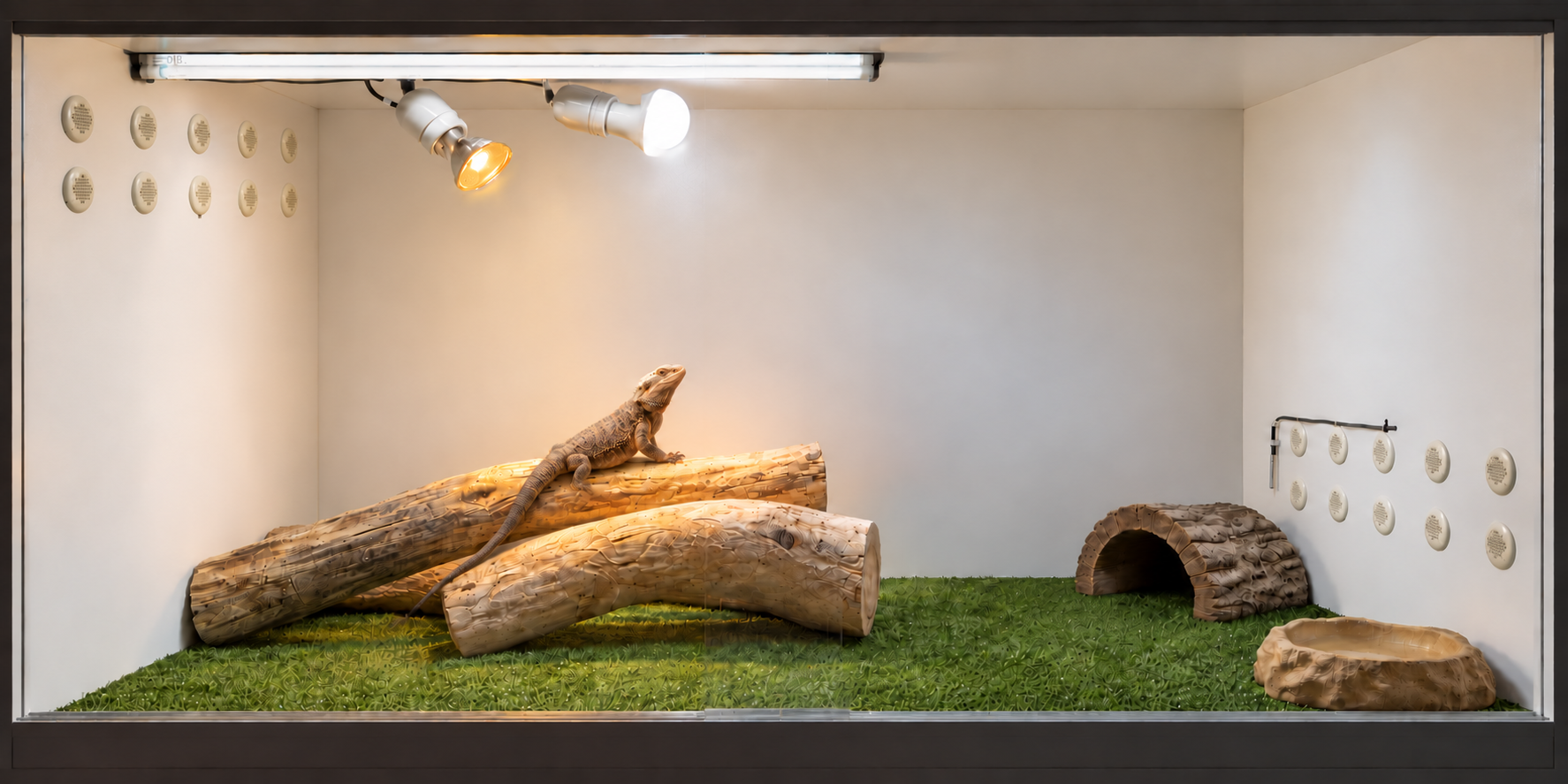
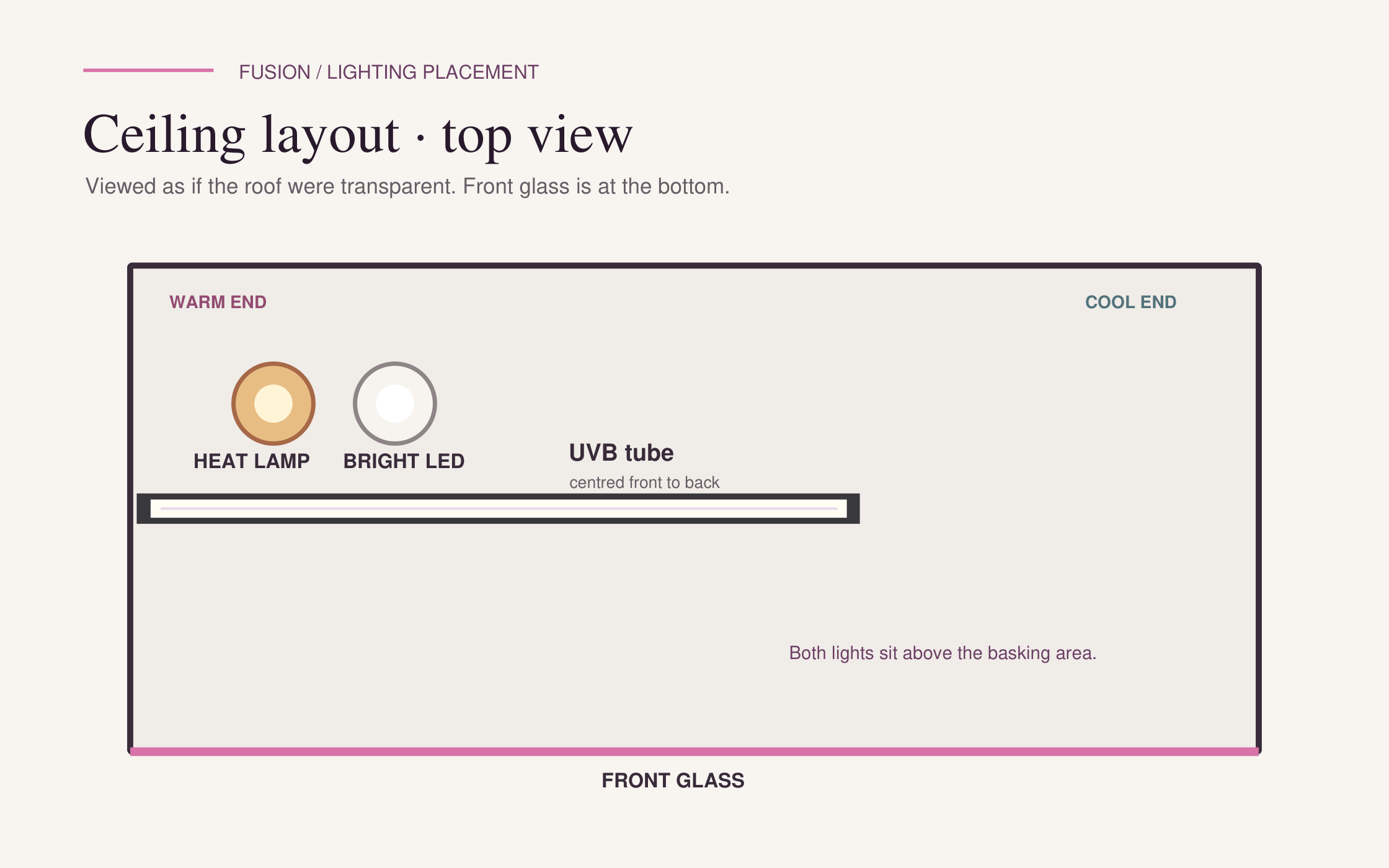
The 3D view shows how the basking structure, hide and water bowl sit beneath the lighting. The ceiling plan shows where the UVB tube, heat lamp and bright LED sit in relation to one another.
The dragon has climbed to the highest point of the logs beneath the basking lamp and UVB. From there it can bask while surveying the enclosure, then move lower along the wood or retreat to the cooler end when it needs less heat or light. The hide offers another place to withdraw, and the water bowl remains accessible on the cool side.
These images illustrate placement and natural choices; they do not replace measuring the actual basking surface, cool end and UVB exposure in your own enclosure.
42–45°C. Dragon climbs to highest point to bask directly under the heat source.
Must overlap the basking zone — spans ½–⅔ from hot end.
Positioned at the cool end. The cool end should sit at approximately 28°C or below.
Always provide a gradient so your dragon can move away from heat as needed.
Functional Basking Structures
The basking structure itself is extremely important and is something many setups get wrong.
In our experience, the best basking surfaces are natural-style logs or branches that gradually taper in height beneath the heat source and UVB. The highest point should sit directly beneath the basking light, with the structure gradually lowering away underneath the UVB zone.
This creates a usable gradient that allows the dragon to naturally regulate itself throughout the day.
Flat basking surfaces such as tiles, pavers, slate platforms, and large flat rocks are often not ideal, particularly for young dragons.
While these surfaces may absorb heat well, they do not create the same functional thermoregulation opportunities as a properly positioned tapered log. A flat surface forces the animal into a single exposure zone with limited adjustment options.
In nature, healthy active bearded dragons are most commonly seen basking on elevated branches, logs, fence posts, and uneven natural surfaces rather than broad flat platforms. One of the more common exceptions is gravid females, which are often observed utilising roads and flatter heat-retaining surfaces while carrying eggs.
This is one reason we strongly favour large tapered logs positioned beneath the heat source and UVB. The highest point should sit directly beneath the basking light, gradually tapering downward through the UVB zone. This creates a usable gradient that allows the dragon to naturally regulate itself throughout the day.
Over the years we have repeatedly seen young dragons housed on flat basking surfaces become inactive, reluctant to bask properly, or simply fail to thrive despite temperatures appearing correct on paper. In many cases, replacing the surface with a large tapered log resulted in dramatic behavioural improvement within days.
The dragon became more active, basked more naturally, moved through the gradient correctly, and began regulating itself the way it was intended to.
The goal is not simply to provide heat. The goal is to provide a functional basking environment the animal can actually use properly.